
Concrete Services in Wake County, NC
From new driveways and patios to foundations, repairs, and full outdoor living spaces — we provide complete residential and light commercial concrete services for homeowners across Garner, Fuquay-Varina, Holly Springs, Apex, Cary, Raleigh, Clayton, Wake Forest, Knightdale, Morrisville, and the surrounding communities.
Concrete Driveway Installation
A concrete driveway is one of the most valuable improvements a Wake County homeowner can make. It’s the first thing visitors and potential buyers see, it takes daily abuse from vehicles and weather, and a properly installed driveway will outlast asphalt by decades. We install full driveways for new construction, replace failing driveways, and extend existing driveways to add parking space for an RV, boat, or extra vehicle.
Every driveway starts with excavation and grading to the correct slope for drainage, followed by a compacted gravel sub-base — this is the step that determines whether a driveway lasts 10 years or 40. We then place reinforcement, pour at the correct thickness for residential traffic (typically 4 inches, more for heavier vehicles), cut control joints to manage natural cracking, and finish with your choice of broom, exposed aggregate, or stamped texture.
Where It’s Used
New home driveways, full driveway replacements, driveway extensions for extra parking, RV and boat pads, and circular or multi-car driveway layouts for larger Wake County properties.
- Lasts 25–40+ years with proper installation and care
- Increases curb appeal and home resale value
- Handles NC’s heat, heavy rain, and occasional freeze cycles
- Low maintenance compared to asphalt or pavers
- Can be finished plain, broomed, or upgraded with stamped/decorative texture
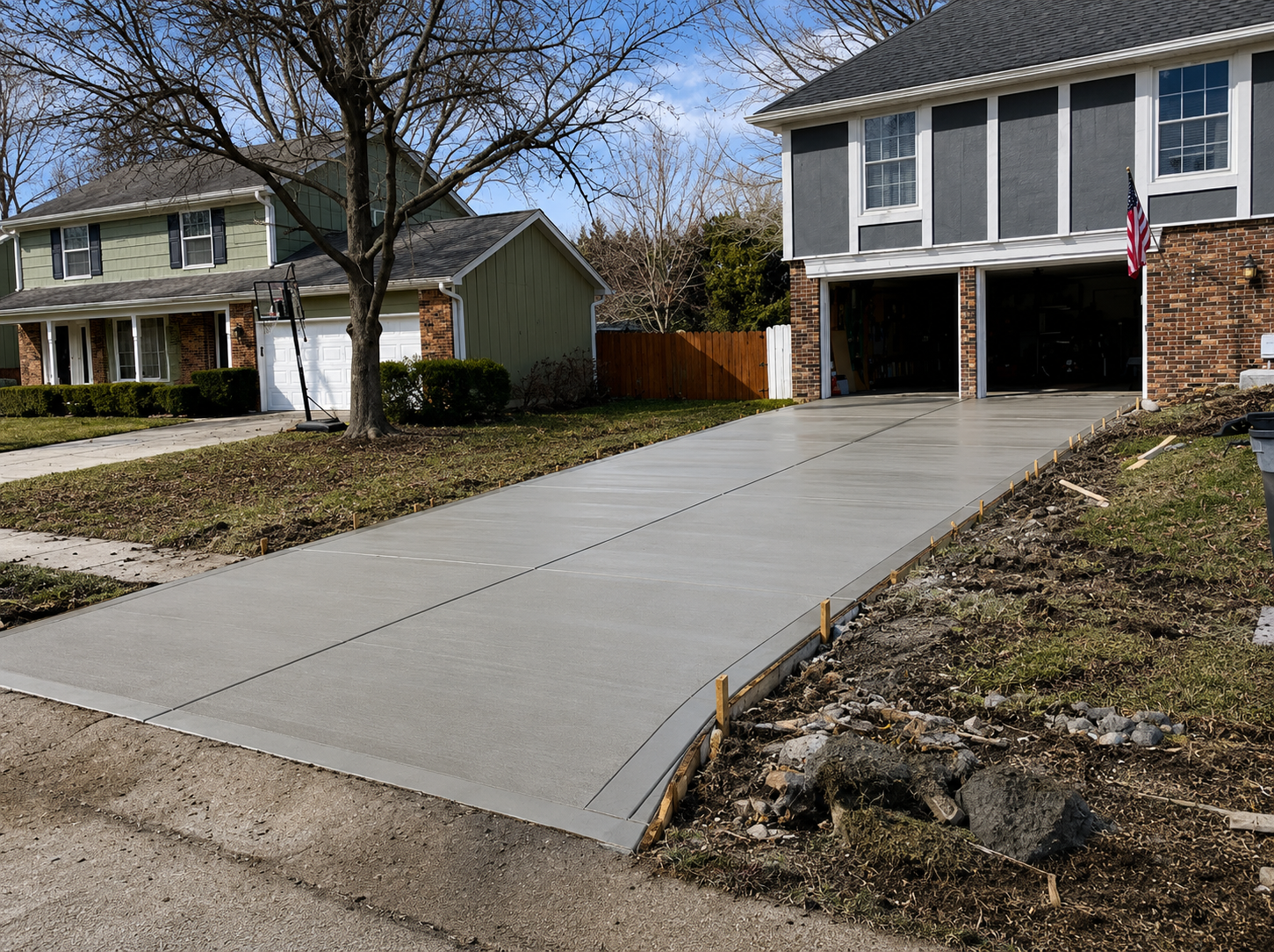
Plain Broom-Finish Driveway — The most common and affordable option. A textured broom finish is dragged across the surface while the concrete is still workable, creating a slip-resistant surface that handles rain well — ideal for NC’s wet seasons.
Exposed Aggregate Driveway — The top layer of cement paste is washed away to reveal the decorative stone aggregate underneath, creating a rugged, textured, non-slip surface with natural stone color variation.
Stamped Concrete Driveway — Patterns resembling brick, cobblestone, or natural stone are pressed into the concrete before it cures, then colored for a high-end look at a fraction of the cost of pavers.
Colored / Stained Driveway — Integral color or surface stain is added to complement your home’s exterior, available in earth tones, charcoal, terracotta, and more.
A new concrete driveway is one of the highest return-on-investment exterior projects for Wake County homes. Beyond the obvious durability and low maintenance, a fresh driveway dramatically improves first impressions — appraisers and buyers consistently rate driveway condition as a top factor in curb appeal.
Concrete also reflects heat better than asphalt, stays cooler underfoot in NC summers, and never needs the periodic sealing and resurfacing that asphalt requires every few years.
How thick should a residential driveway be? Standard residential driveways are poured at 4 inches thick. If you plan to park RVs, boats, or heavier trucks, we recommend 5–6 inches with additional reinforcement.
Will my new driveway crack? All concrete develops hairline cracks over time due to natural shrinkage — this is normal. Properly placed control joints direct cracking to predictable, nearly invisible lines instead of random cracks across the surface.
How soon can I park on my new driveway? Foot traffic is fine after 24–48 hours. We recommend waiting at least 7 days before driving on it, and avoiding heavy vehicles for the full 28-day cure period.
Concrete Patios & Outdoor Living Spaces
A concrete patio extends your living space outdoors — perfect for grilling, entertaining, dining, or simply enjoying Wake County’s mild spring and fall evenings. We design and pour patios of any shape and size, from simple rectangular slabs to multi-level patios connected by steps, walkways, and seating walls.
Patios can be left with a plain broom finish for a clean, modern look, or upgraded with stamped patterns, exposed aggregate, or saw-cut decorative scoring. We also build patios that integrate with fire pits, outdoor kitchens, and pergola footings — giving you a complete outdoor living area built to handle furniture, foot traffic, and NC weather year-round.
Where It’s Used
Backyard entertainment areas, dining and grilling spaces, pool surrounds, multi-level outdoor living areas, and as a base for outdoor kitchens, pergolas, and fire pits.
- Creates usable outdoor living space year-round
- Wide range of finishes — plain, stamped, stained, or exposed aggregate
- Holds up to furniture, grills, and heavy foot traffic
- Pairs well with walkways, steps, and retaining walls for a complete design
- Adds usable square footage that boosts home value
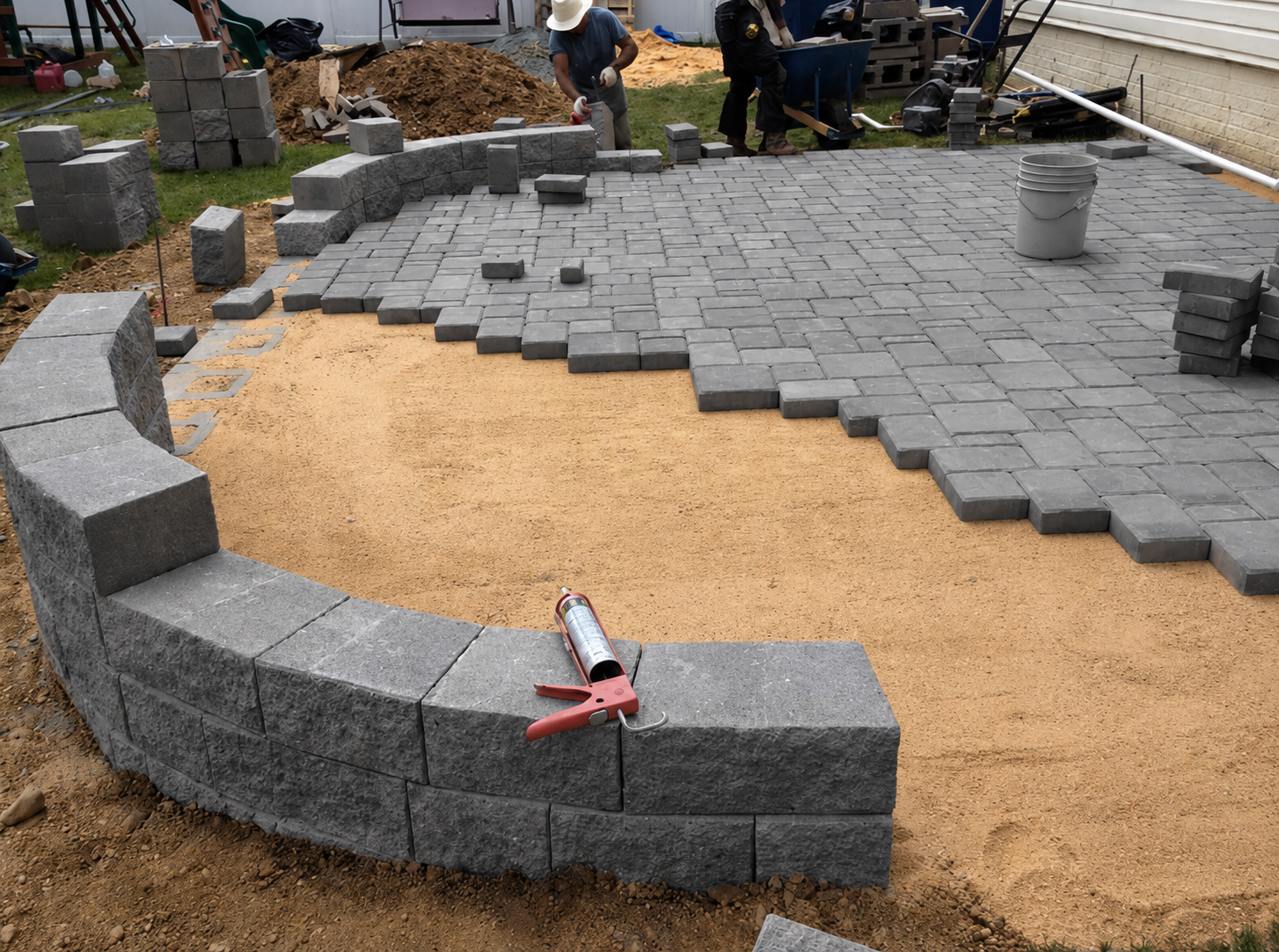
Standard Broom-Finish Patio — Clean, simple, and budget-friendly with a textured non-slip surface.
Stamped Flagstone or Brick Pattern Patio — Mimics the look of natural stone or brick pavers at a lower cost and with fewer weeds and shifting joints over time.
Multi-Level Patios — Stepped patio sections connected by concrete steps, ideal for sloped Wake County yards.
Patio with Integrated Fire Pit Pad — A reinforced section designed to safely support a fire pit, often paired with seating wall footings.
Unlike wood decking, concrete patios don’t rot, warp, splinter, or require annual staining. They handle direct sun, heavy rain, and humidity without degrading — making them ideal for the North Carolina climate.
A well-designed patio also functionally expands your home’s livable space at a much lower cost per square foot than a home addition, while adding genuine appeal for future buyers.
Can a patio be added to an existing concrete slab? Yes, in many cases we can extend an existing patio or pour an adjoining section with a matching or complementary finish.
Do patios need drainage planning? Yes — every patio is sloped slightly away from the home’s foundation to direct water away, which we account for during the design and grading phase.
How long until furniture can go on a new patio? Light furniture is generally fine after about a week, though full curing takes 28 days for maximum strength.
Stamped & Decorative Concrete
Stamped concrete gives you the high-end appearance of natural stone, brick, slate, or wood — at a fraction of the material and labor cost of installing the real thing. We press textured stamps into the concrete while it’s still workable, then apply color hardeners and release agents to create realistic stone-like tones and textures.
Decorative concrete goes beyond stamping — it also includes integral and acid-stained coloring, saw-cut scoring patterns, and exposed aggregate finishes. These options let us match or complement your home’s existing brick, siding, or landscaping for a cohesive look across driveways, patios, walkways, and pool decks.
Where It’s Used
Driveways, front walkways, patios, pool decks, and entryways where homeowners want the look of pavers, flagstone, brick, or natural stone without the higher cost and long-term maintenance of those materials.
- Achieves the look of stone, brick, or pavers at lower cost
- Wide range of patterns and color combinations available
- No weeds, shifting, or settling joints like with pavers
- Sealed finish protects color and surface for years
- Can be matched across multiple areas of your property
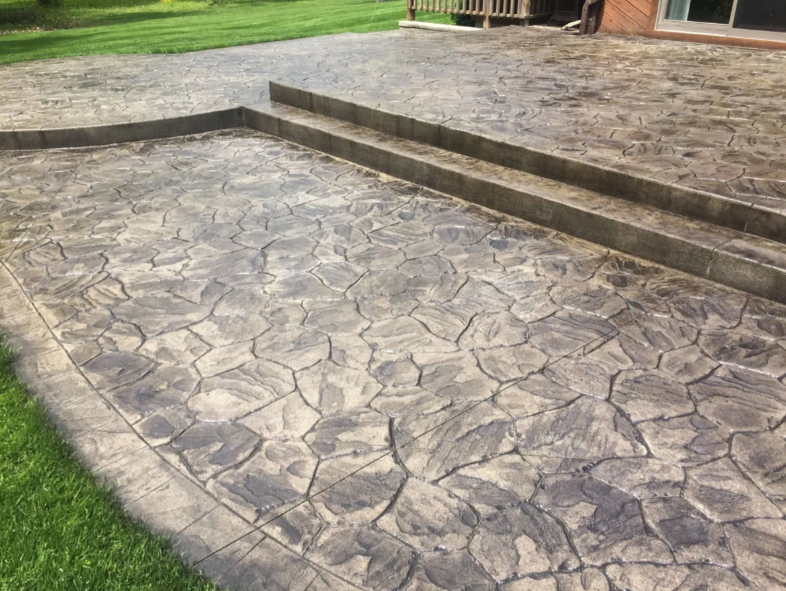
Ashlar Slate — Large, irregular flagstone-style pattern, one of the most popular choices for patios and walkways.
Running Bond Brick — Classic brick-laid pattern, great for matching traditional brick homes common throughout Wake County.
Cobblestone — Smaller interlocking stone pattern, often used for driveways and borders.
Wood Plank — Realistic wood-grain texture, popular for pool decks where a “deck” look is desired without wood maintenance.
Color can be added two ways — integral color mixed into the concrete itself for consistent tone throughout, or color hardener applied to the surface during stamping for richer, multi-tone effects. We also offer acid staining for an aged, variegated look on existing or new concrete.
All decorative concrete is sealed after curing to protect the color and texture, with resealing recommended every 2–3 years depending on sun and traffic exposure.
Is stamped concrete slippery? A properly sealed stamped surface with a textured pattern actually provides good traction, and we can add anti-slip additives to sealers for pool decks and steps.
How much more does stamped concrete cost vs. plain? Stamped concrete typically costs more than plain broom-finish concrete due to the additional labor, color, and sealing — but remains significantly less than natural stone or pavers for the same look.
Does the color fade over time? Sealed color holds well for years, though resealing every 2–3 years keeps colors vibrant and protects against UV fading and surface wear.
Concrete Foundations & Slabs
Every structure starts with a properly built foundation. We pour monolithic slabs, footings, and foundation walls for new homes, additions, garages, sheds, workshops, and accessory dwelling units across Wake County. Getting this step right — correct grading, compacted sub-base, proper reinforcement, and accurate concrete mix — is what everything else gets built on.
We work closely with homeowners, builders, and contractors to ensure foundations meet North Carolina building code requirements, including proper depth, reinforcement placement, and vapor barriers where required. Whether it’s a small shed pad or a full home addition foundation, we bring the same precision to every pour.
Where It’s Used
New home construction, home additions, detached garages, workshops, sheds, accessory dwelling units (ADUs), HVAC equipment pads, and generator pads.
- Built to NC residential building code requirements
- Proper sub-base prep prevents future settling and cracking
- Reinforcement placed for long-term structural integrity
- Suitable for additions, garages, sheds, and ADUs
- Coordinated scheduling with builders and other trades
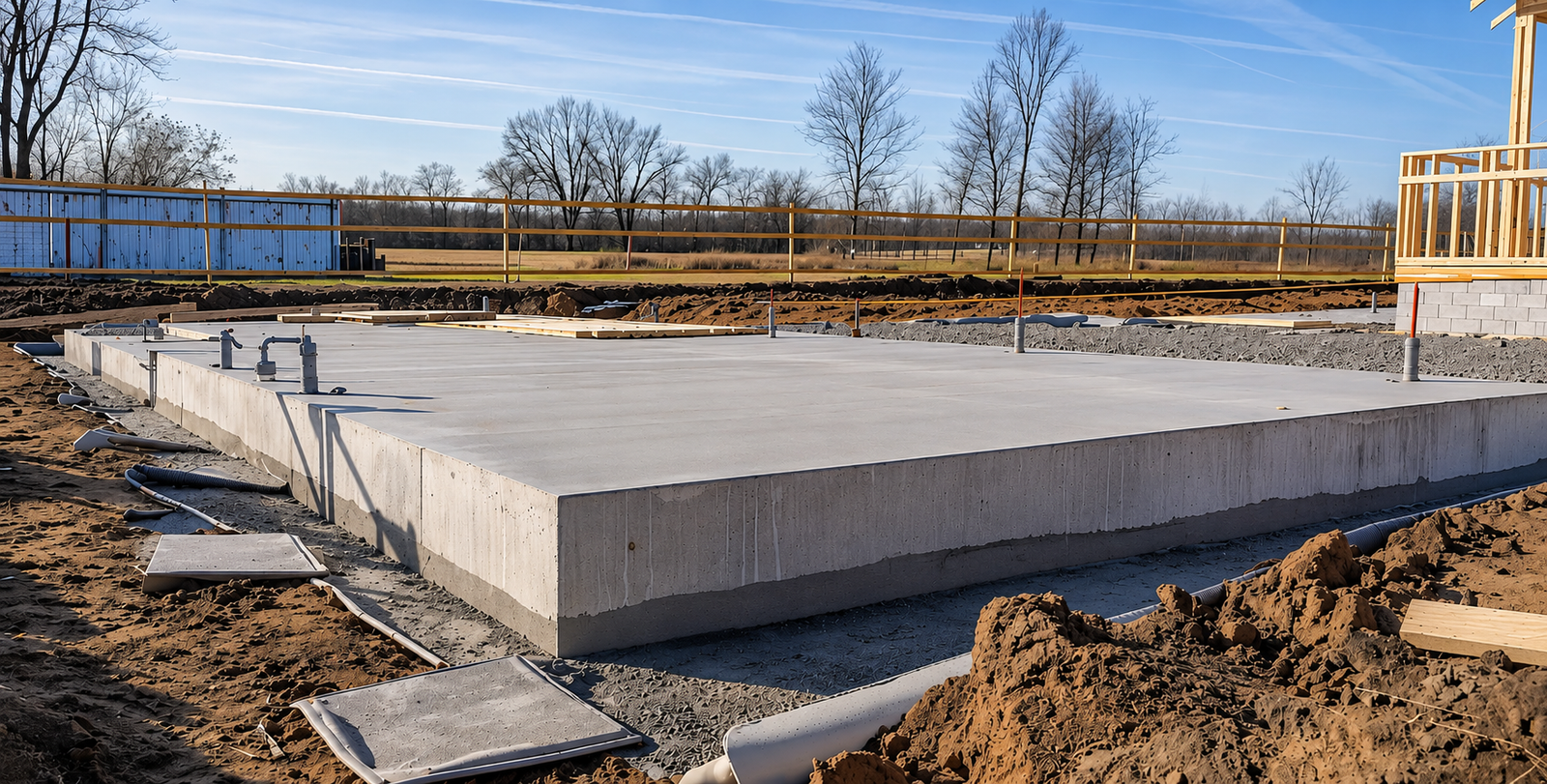
Monolithic Slab Foundation — The footing and floor slab are poured as a single unit, common for garages, sheds, and additions in areas without deep frost lines.
Stem Wall Foundation — A footing is poured first, then a concrete wall is built up to support the floor structure above — often used for crawl space homes.
Equipment & Utility Pads — Smaller reinforced slabs for HVAC units, generators, hot tubs, and utility equipment.
The compacted gravel sub-base beneath a slab is what prevents future settling, cracking, and water pooling issues. Skipping or under-compacting this step is the single most common cause of foundation problems years down the line — which is why we never shortcut this stage regardless of project size.
Do I need a permit for a new slab or foundation? Most new foundations, additions, and many shed/garage slabs require a permit in Wake and Johnston County — we can advise on requirements for your specific project.
How thick does a garage or shed slab need to be? Typically 4 inches for sheds and standard garages, with thicker slabs and additional reinforcement for heavier vehicles or equipment.
Can you pour a foundation for a builder I’m already working with? Yes — we regularly coordinate directly with builders, framers, and other trades on new construction and addition projects.
Concrete Walkways & Pathways
A well-built walkway does more than connect two points — it shapes how people move through and experience your property. We pour front entry walkways, side yard paths, garden walkways, and pathways connecting driveways to back patios, all finished to match your home’s existing concrete or styled as a standalone feature.
Walkways are graded for proper drainage and finished with broom texture for slip resistance, or upgraded with stamped or exposed aggregate patterns to complement a driveway or patio. We can also incorporate curves, varying widths, and integrated lighting conduit for a finished, designed look rather than a basic straight slab.
Where It’s Used
Front entry walkways, side yard access paths, garden and landscape pathways, connections between driveways and patios, and ADA-friendly accessible routes.
- Improves curb appeal and defines property layout
- Slip-resistant broom finish standard on all walkways
- Can be styled to match driveway or patio finishes
- Proper grading prevents water pooling near the home
- Durable, low-maintenance alternative to pavers or gravel
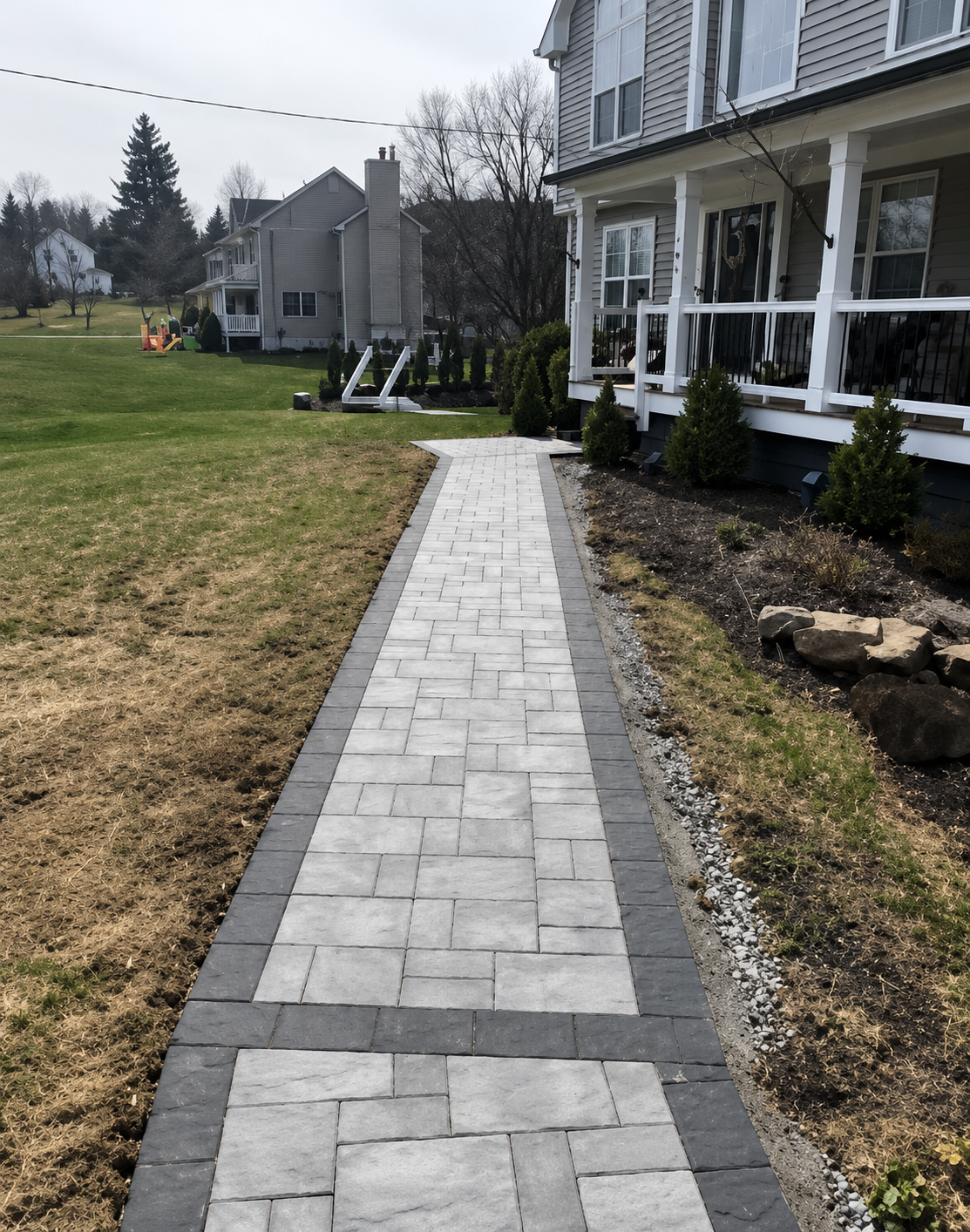
Straight Entry Walkways — Direct paths from driveway to front door, the most common residential walkway type.
Curved & Landscaped Pathways — Designed to follow garden beds, trees, or property contours for a natural look.
Stepped Walkways — Incorporate steps for sloped yards, connecting different elevation changes safely.
Beyond curb appeal, a properly graded concrete walkway directs water away from your home’s foundation and prevents the muddy, uneven paths that develop from foot traffic on grass or gravel over time.
How wide should a walkway be? 3 feet is standard for single-file walkways, while 4–5 feet allows two people to walk side by side comfortably.
Can a walkway be added alongside an existing driveway? Yes — we regularly add walkways adjacent to existing driveways and can match the finish or create contrast with a different texture or color.
Concrete Repair & Resurfacing
Not every concrete problem requires a full replacement. We repair cracked, sunken, spalling, or pitted concrete surfaces across Wake County — often restoring driveways, patios, and walkways to a like-new appearance at a fraction of replacement cost. Our team will give you an honest assessment of whether repair or replacement makes more sense for your specific situation.
Repair options include crack filling and sealing, mudjacking or slab leveling for sunken sections, and full resurfacing with a new overlay that bonds to the existing slab and gives it a fresh, uniform finish — including the option to add stamped texture or color during the resurfacing process.
Where It’s Used
Cracked driveways and patios, sunken or uneven slab sections, pitted or spalling garage floors, faded or stained concrete in need of a refresh, and trip-hazard sidewalk sections.
- Often more affordable than full replacement
- Restores safety by eliminating trip hazards and uneven surfaces
- Resurfacing can add stamped texture or new color to old concrete
- Crack repair prevents water infiltration and further damage
- Honest evaluation — we won’t push replacement when repair will do
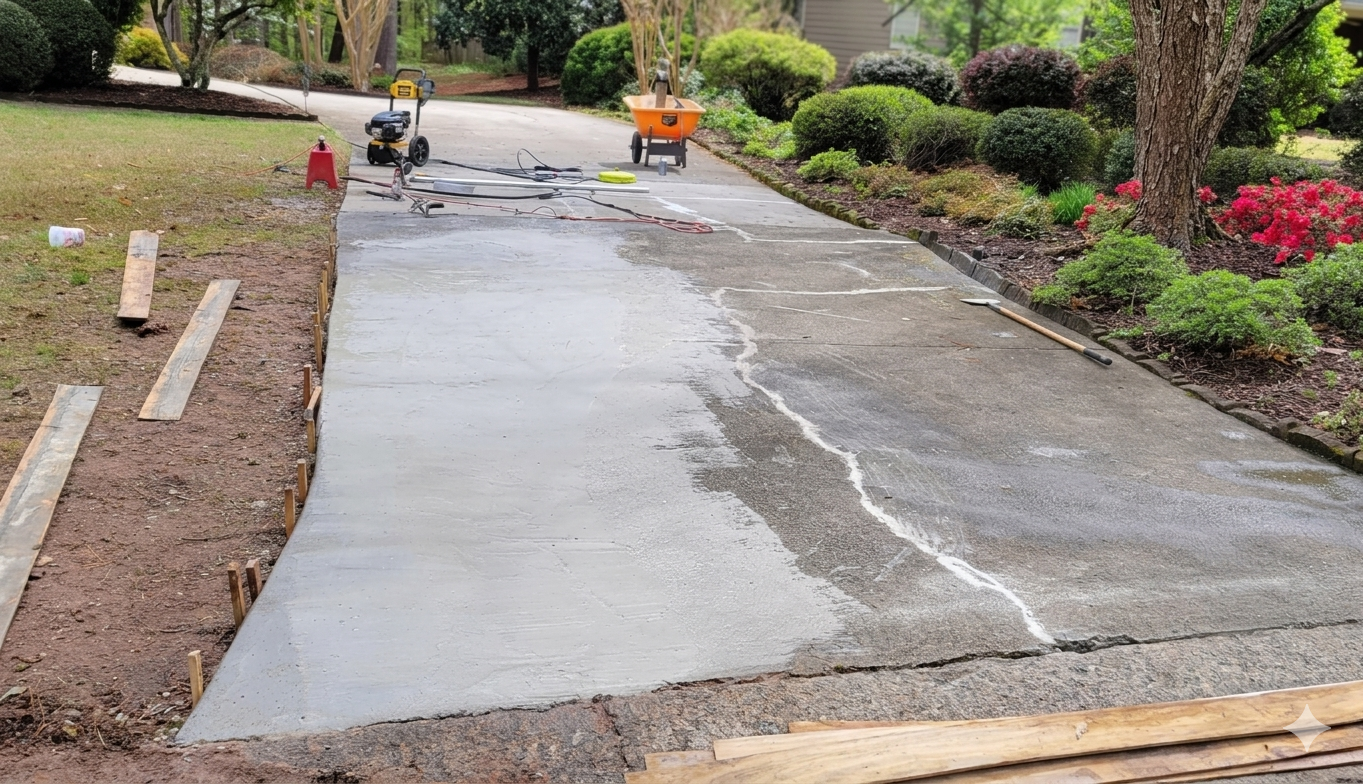
Crack Repair & Sealing — Cleans and fills cracks to prevent water infiltration, weed growth, and further widening from freeze-thaw cycles.
Slab Leveling (Mudjacking) — Raises sunken sections of concrete back to level by injecting material beneath the slab, avoiding the cost and disruption of full removal.
Concrete Resurfacing / Overlay — A bonding overlay is applied over existing concrete, which can be left smooth, broomed, or stamped for a completely refreshed look.
We assess the extent and cause of the damage, the condition of the sub-base beneath the slab, and the age of the existing concrete. Surface-level issues like minor cracking, staining, or small areas of spalling are usually good candidates for repair or resurfacing. Widespread structural cracking, significant settling, or sub-base failure typically point toward replacement for a long-term fix.
Will a repaired crack be invisible? Crack repairs are durable and functional but may show a slight line, especially on textured or colored surfaces. Resurfacing can hide repairs under a new uniform finish.
How long does resurfacing last? A properly applied overlay can last many years with periodic resealing, similar to a new decorative concrete surface.
Can you match the color of my existing driveway during repair? We do our best to match existing color and texture, though some variation is normal between old and new concrete.
Retaining Walls & Concrete Walls
Wake County’s terrain ranges from flat to gently rolling, and many properties have grade changes that need to be managed — whether that’s a sloped backyard, a raised garden bed, or a driveway that sits below the surrounding yard. We design and build poured concrete and block retaining walls that hold back soil, prevent erosion, and create usable level space on sloped lots.
Beyond function, retaining walls add structure and visual definition to landscaping — framing planting beds, creating tiered yard levels, or forming the backbone of an outdoor living area. We engineer wall height, drainage, and footing depth based on soil conditions and the load the wall needs to hold.
Where It’s Used
Sloped backyards, raised garden and planting beds, driveway and patio grade transitions, erosion control along property lines, and tiered landscaping designs.
- Creates usable level space on sloped properties
- Prevents soil erosion and protects landscaping investments
- Engineered drainage prevents water pressure buildup behind the wall
- Adds structure and visual definition to yard design
- Built to handle the specific soil and grade conditions of your property
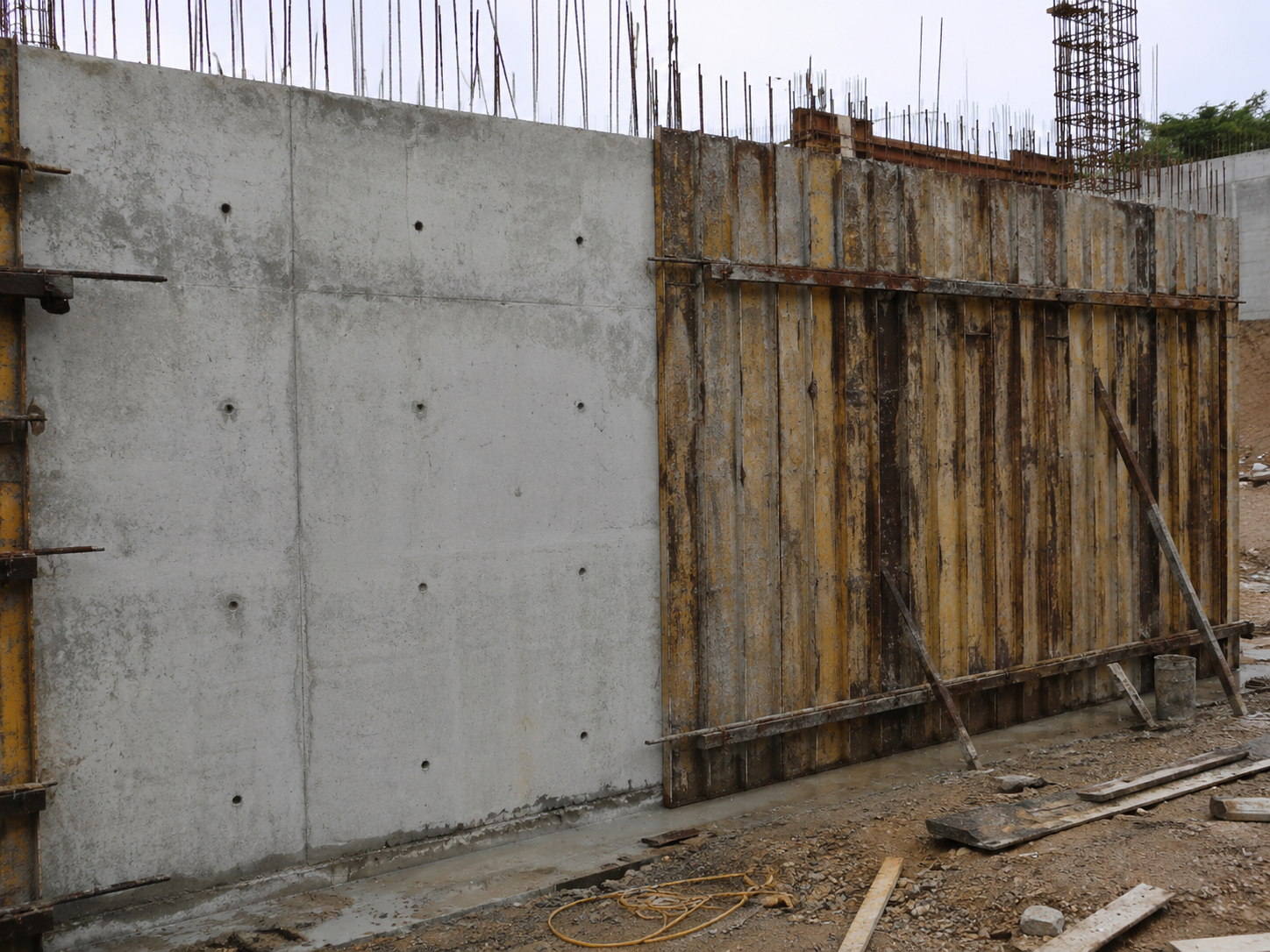
Poured Concrete Walls — Solid, formed concrete walls for taller or higher-load applications, offering a clean modern look.
Segmental Block Walls — Interlocking concrete blocks stacked without mortar, popular for garden beds and shorter walls with flexible design options.
Tiered / Terraced Walls — Multiple shorter walls stepped up a slope, often more cost-effective and visually appealing than a single tall wall.
Water that builds up behind a retaining wall creates pressure that can cause the wall to lean, crack, or fail over time. Every wall we build includes proper backfill material and drainage solutions appropriate to the wall height and soil type — this is the difference between a wall that lasts decades and one that fails within a few years.
Do retaining walls need a permit? Walls over a certain height (commonly 4 feet, depending on local code) typically require a permit and may need engineering — we can advise based on your specific project.
How long do concrete retaining walls last? With proper drainage and construction, concrete and block retaining walls commonly last 30+ years.
Can a retaining wall double as seating? Yes — shorter walls (typically under 24 inches) are often designed with a flat cap suitable for seating around patios and fire pits.
More Concrete Services We Provide
In addition to the core services above, our crews handle the following concrete work for homeowners and light commercial properties throughout Garner, Fuquay-Varina, Holly Springs, Apex, Cary, Raleigh, Clayton, Wake Forest, Knightdale, Morrisville, and surrounding Wake and Johnston County communities.
Garage Floor Slabs & Coatings
New garage floor slabs poured to handle vehicle weight and daily use, plus resurfacing and epoxy-style coatings for existing garage floors that are cracked, stained, or dusting.
- Resists oil stains, hot tire marks, and cracking
- Coatings available for existing garage slabs
- Built for daily vehicle and storage loads
Pool Deck Concrete
Pool surrounds and decks poured with slip-resistant finishes designed for bare feet and wet conditions — including broom, knockdown, and stamped textures that stay cooler in direct sun.
- Slip-resistant finishes safe for wet feet
- Cooler surface temperatures than plain smooth concrete
- Designed with proper drainage away from the pool
Concrete Steps & Stairs
Front entry steps, side and back yard stairs, and stepped transitions between patios, walkways, and yard levels — built with proper rise and run for safety and code compliance.
- Safe, code-compliant rise and run on every step
- Can be finished plain, broomed, or stamped to match patios
- Connects multi-level outdoor spaces safely
Concrete Curbing & Landscape Edging
Continuous concrete curbing defines garden beds, driveway edges, and lawn borders — a permanent, low-maintenance alternative to plastic or metal edging that won’t shift or need replacing.
- Permanent landscape borders that never need replacing
- Defines driveway edges and garden bed lines cleanly
- Available in multiple shapes, colors, and finishes
Exposed Aggregate Concrete
The decorative stone aggregate within the concrete mix is exposed at the surface for a natural, textured stone look — popular for driveways, walkways, and pool decks throughout Wake County.
- Naturally slip-resistant, ideal for driveways and pool decks
- Unique stone texture that doesn’t fade like surface color
- Available with local or decorative aggregate blends
Concrete Patios with Fire Pit Pads
A reinforced concrete pad sized and positioned for a fire pit, integrated into a larger patio design — often paired with a seating wall and surrounding hardscape for a complete outdoor gathering space.
- Reinforced pad designed for fire pit weight and heat
- Integrated into your overall patio layout
- Pairs well with seating walls and outdoor lighting
Light Commercial Concrete Flatwork
Sidewalks, parking pads, equipment pads, and flatwork for small businesses, churches, and light commercial properties — built to handle foot traffic and light vehicle use across Wake County.
- Sidewalks, walkways, and small parking areas
- Equipment and dumpster pads
- Built to handle commercial foot and light vehicle traffic
Concrete Demolition & Removal
Removal of old, cracked, or unwanted concrete driveways, patios, slabs, and walkways — including haul-away — to clear the way for new construction or a fresh installation.
- Full removal and haul-away of old concrete
- Clears the site for new driveways, patios, or additions
- Site graded and prepped for the next phase of work
How Every Project Works
No matter which service you need, every project across Wake County follows the same proven process — from first estimate to final finish.
Free Estimate Visit
We visit your property, measure the site, and give you a written quote before any commitment.
Site Preparation
Excavation, grading, and compacted gravel sub-base — the foundation that makes concrete last 30+ years.
Pour & Finish
Correct concrete mix for NC climate, reinforcement placed, control joints cut, your chosen finish applied.
Cure & Handover
Curing compound applied. We walk you through the full curing timeline before we leave the site.
Concrete Services Across Wake & Johnston County, NC
All 15 services above are available throughout our full service area. Whether you’re in a fast-growing Wake County suburb or a long-established Raleigh neighborhood, our crews bring the same proven process and honest pricing to every job.
Not sure if we cover your address? Call us — if we can get there, we will.
Concrete Services FAQ — Wake County, NC
We offer a full range of residential and light commercial concrete services across Wake County including driveways, patios, stamped and decorative concrete, foundations and slabs, walkways, repair and resurfacing, retaining walls, garage floors, pool decks, steps, curbing, exposed aggregate, fire pit patios, commercial flatwork, and demolition.
Yes. We provide free, no-obligation written estimates for every concrete project across Wake County and Johnston County, including Garner, Fuquay-Varina, Holly Springs, Apex, Clayton, and Raleigh. Contact us to schedule a visit.
Concrete is typically firm enough to walk on within 24 to 48 hours, safe for vehicle traffic after about 7 days, and reaches full strength at around 28 days. We walk every customer through the curing timeline for their specific project before we leave the site.
Yes, we are fully licensed and insured to perform concrete work throughout North Carolina, with general liability insurance and workers compensation coverage on every project. Documentation is available on request.
We serve Garner, Fuquay-Varina, Holly Springs, Apex, Cary, Raleigh, Clayton, Wake Forest, Knightdale, Morrisville, Angier, Benson, and the surrounding Wake County and Johnston County areas. If you’re unsure whether we cover your address, just give us a call.
Absolutely — many projects combine several services, such as a new driveway with a connecting walkway, or a patio with steps and a retaining wall. We design and quote these as a single coordinated project so everything is finished to match.
Request a Free Concrete Estimate
Tell us about your project and we will be in touch within 24 hours with a free written estimate. No obligation, no pressure.
Free Concrete Estimate — Wake County, NC
We visit your property, assess the job, and give you a clear written quote — usually within 24 hours. No pressure, no obligation.
+1 (984) 600-6557Mon–Fri 7am–6pm | Sat 8am–2pm | Serving Wake & Johnston County, NC
Request Free Quote Online