
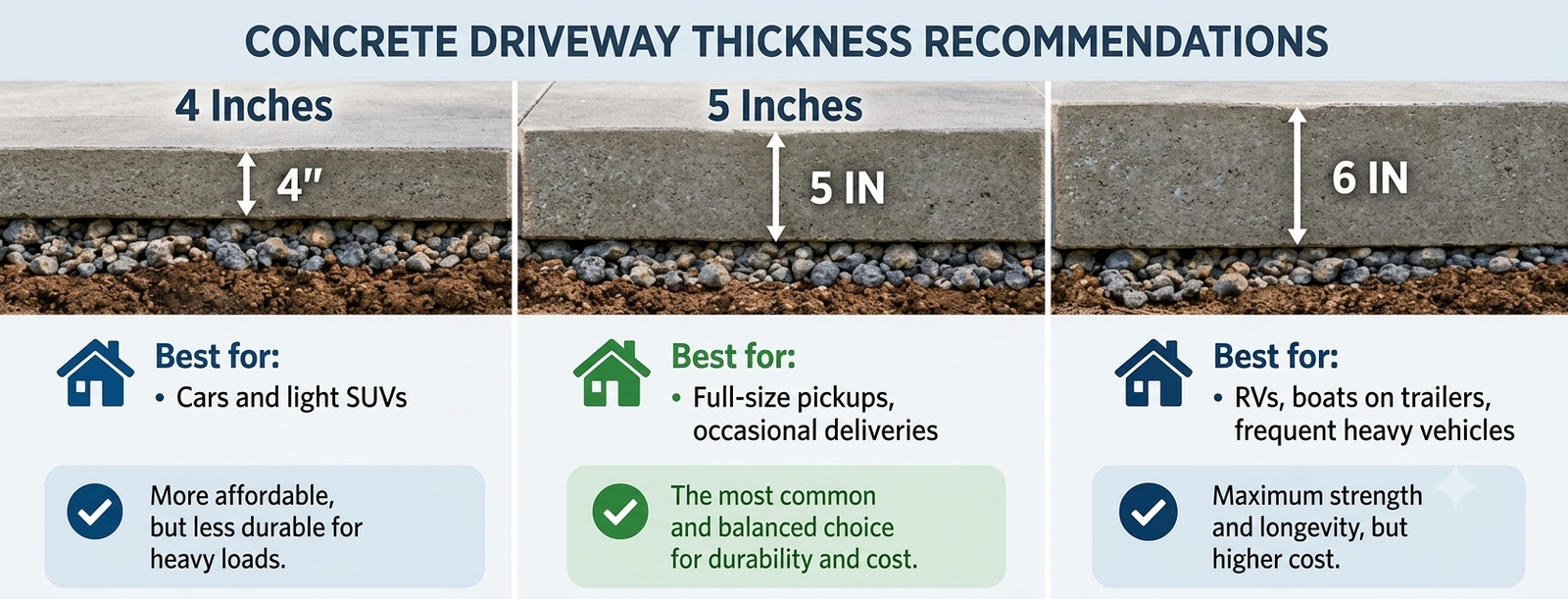
How thick should a concrete driveway be? For most homes, at least 4 inches. If you park heavier vehicles on it — a full-size pickup, an RV, or a boat trailer — or if delivery and trash trucks drive over it, go with 5 to 6 inches. The rest of this guide explains how to choose, why the ground under the concrete matters as much as the concrete itself, and what to ask a contractor before you sign.
Need exact numbers? Try our free driveway concrete calculator.
Quick answer: concrete driveway thickness by use
| What will use the driveway | Typical thickness |
|---|---|
| Cars and light SUVs | 4 inches |
| Full-size pickups, occasional deliveries | 5 inches |
| RVs, boats on trailers, frequent heavy vehicles | 6 inches |
| Very heavy or constant loads (equipment, commercial trucks) | Ask for a written spec; consider an engineer |
These are common residential guidelines, not a code requirement. Your contractor should tell you which thickness they are bidding and why.
Why 4 inches is the minimum, and where it falls short
Four inches of concrete handles the weight of everyday passenger vehicles when it sits on a properly prepared base. Where it struggles is at the points that take the most stress: the edges, the corners, and the apron where the driveway meets the street. A heavy vehicle turning or driving off the edge puts far more load on those spots than a car rolling down the middle. That is why many contractors thicken the edges, or simply pour 5 inches across the whole driveway when trucks or an RV are in the picture.
If you are deciding between 4 and 5 inches, think about the heaviest thing that will ever sit on it, not just what you drive today. Driveways last decades, and a new owner may park something very different.
In Wake County clay, the base matters as much as thickness
The concrete thickness for a driveway is only half of the specification. In the Raleigh area, most lots sit on red clay that swells when it is wet and shrinks when it dries. Concrete poured directly on that soil, or on a thin or poorly compacted base, will move and crack no matter how thick it is.
A well-built driveway usually has:
- A compacted crushed-stone base, commonly about 4 inches deep, over soil that has been graded so water drains away from the slab.
- Drainage planned in advance, so water does not pool at the edges and soften the soil underneath.
- Consistent thickness across the pour, which is easy to check with a measuring stick before the concrete arrives.
Spending money on a deeper base and better drainage usually does more for the life of a driveway than adding another inch of concrete on top of a weak foundation.
Concrete strength, reinforcement and control joints
Three more details belong in the same conversation as thickness:
- Concrete strength. Residential driveways are commonly poured with mixes in the range of 3,000 to 4,000 PSI. Ask which mix your contractor uses. In areas with freezing winters, air-entrained concrete helps the surface resist damage from freeze and thaw; Raleigh-area winters have occasional freezes, so it is worth asking about.
- Reinforcement. Wire mesh, rebar, or fibers help hold hairline cracks tight. They do not turn a thin slab into a strong one, so reinforcement is an addition to proper thickness, not a substitute for it.
- Control joints. These are the planned grooves that tell the concrete where to crack. A common rule of thumb is to space them roughly 2 to 3 times the slab thickness in feet, so a 4-inch slab gets joints about every 8 to 12 feet.
How driveway thickness affects cost
Ready-mix concrete is sold by the cubic yard, so thickness changes the amount you buy. For a typical 12 by 24 foot driveway (288 square feet), the concrete alone works out to roughly:
| Thickness | Concrete needed | Compared with 4 inches |
|---|---|---|
| 4 inches | about 3.6 cubic yards | baseline |
| 5 inches | about 4.4 cubic yards | about 25% more concrete |
| 6 inches | about 5.3 cubic yards | about 50% more concrete |
Contractors normally add 5 to 10 percent for waste and uneven ground. The concrete is only part of the bill, though. Labor, forms, base preparation, and finishing cost about the same whether the slab is 4 or 6 inches, so the total price rises by less than the concrete volume does. For current price ranges, see our guide to concrete driveway cost in Fuquay-Varina, NC.
Check permits and HOA rules before you pour
The part of a driveway that meets the street, often called the apron or curb cut, is usually regulated by your town, and many HOAs have their own rules on width, finish, and materials. These rules differ between Raleigh, Cary, Apex, Garner, and other towns, so confirm what applies to your address with your town’s public works or transportation office and your HOA before work starts.
Questions to ask a contractor before you sign
- What thickness are you bidding, and why that number for my vehicles?
- How deep is the stone base, and how will you compact it?
- What concrete strength and mix will you order?
- What reinforcement is included, and how will the control joints be laid out?
- How will water drain off the finished driveway?
- Is the thickness written into the quote?
A contractor who answers these clearly is usually one who builds driveways that last. A vague answer to the thickness question is worth a second quote.
Driveway thickness FAQ
How thick is a concrete driveway usually?
Most residential concrete driveways are 4 inches thick. Driveways that carry heavier vehicles such as full-size trucks, RVs, or boats are usually poured 5 to 6 inches thick.
Is a 4-inch concrete driveway enough?
For cars and light SUVs on a well-prepared, compacted base, 4 inches is the accepted minimum and works well. It is a weaker choice wherever heavy vehicles will drive, especially at the edges and where the driveway meets the street.
How thick should concrete be for a driveway that holds an RV or heavy truck?
Plan on 5 to 6 inches for RVs, boats on trailers, and heavy pickups. For very heavy or frequent loads such as delivery trucks or equipment, ask for a written specification and consider an engineer’s recommendation.
Does a thicker concrete driveway crack less?
Thickness helps a driveway carry weight, but most cracking comes from soil movement, poor base preparation, missing control joints, or improper curing. A thick slab on a poor base can still crack.
How long before I can drive on a new concrete driveway?
Concrete is usually firm enough for foot traffic in 24 to 48 hours and for vehicles after about 7 days. It reaches its full design strength at 28 days.
Planning a new driveway? We install new concrete driveways and pavers in Raleigh, Cary, Apex, and Fuquay-Varina, and across Wake County. Tell us about your project and we will send a free written estimate.
This guide is general information. Your soil, local code, and HOA rules decide the final specification for your driveway, so confirm details with your contractor and your town.