
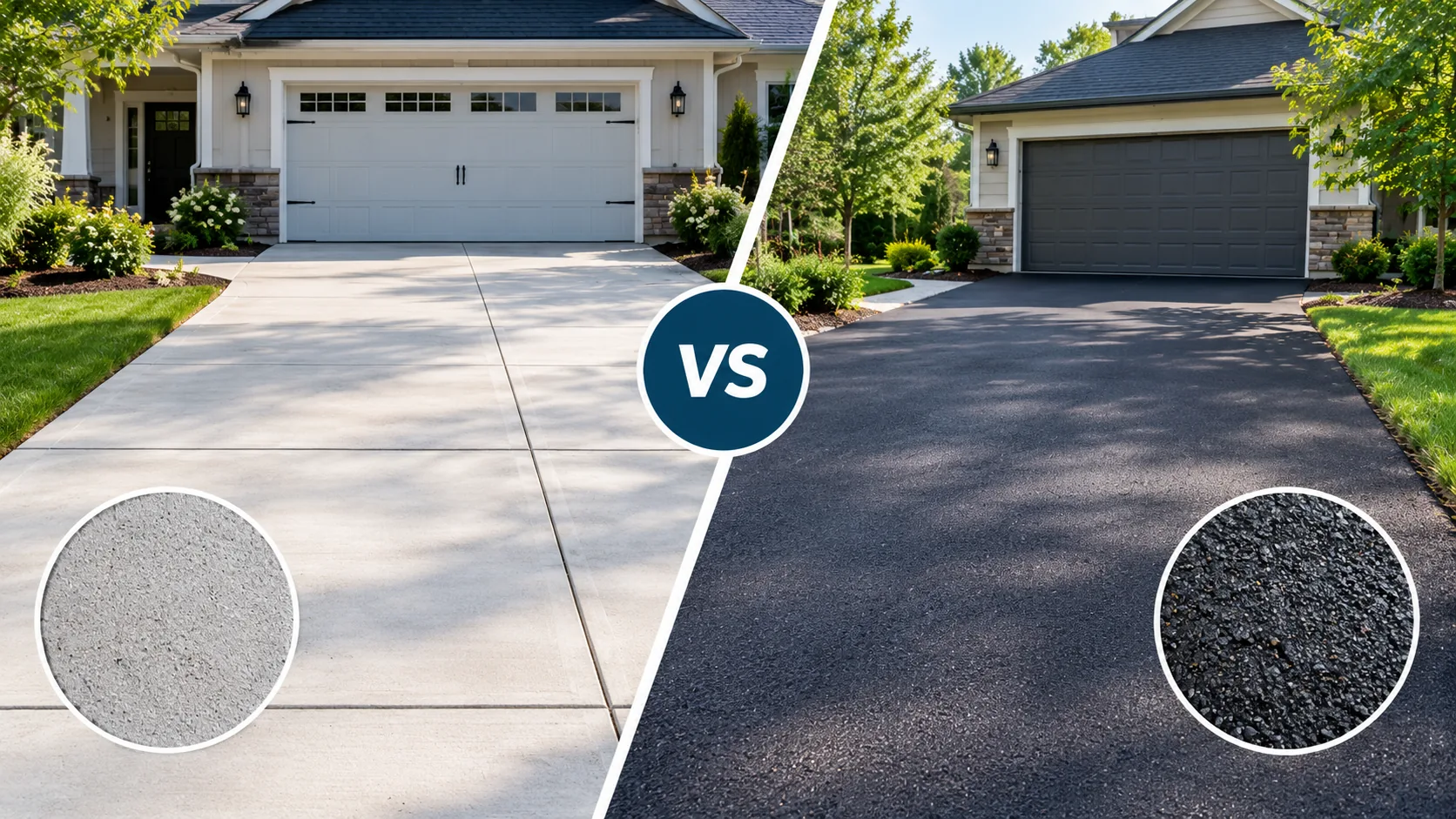
Concrete or asphalt driveway? For most homeowners who plan to stay in their house, concrete is usually the better long-term choice in North Carolina. It costs more up front, but it typically lasts longer and needs less upkeep. Asphalt wins on installation price and on how easily it is patched. We install concrete driveways and pavers, not asphalt, so we have a bias, but this guide covers where asphalt is the smarter pick too.
Concrete vs asphalt driveway at a glance
| Concrete | Asphalt | |
|---|---|---|
| Upfront cost | Higher | Lower |
| Typical lifespan | 30+ years, sometimes 50 | About 15 to 20 years, up to 30 with care |
| Maintenance | Low; optional sealing | Sealcoat every few years |
| In summer heat | Stays cooler | Gets hot, can soften |
| Look and options | Broom, stamped, stained, exposed aggregate | Black only |
| Repairs | Cracks are harder to hide | Easier and cheaper to patch |
| Ready for cars | About 7 days | A few days |
| Typical thickness | 4 to 6 inches | Commonly 2 to 3 inches |
Both materials sit on a compacted stone base, and that base matters as much as the surface. For concrete, see our guide on how thick a concrete driveway should be.
Pavement, cement, asphalt: what the words mean
If you searched “pavement vs concrete” or “cement vs pavement,” here is the short version. For a driveway, pavement almost always means asphalt, the black surface made with bitumen. Cement is an ingredient, not the finished surface: concrete is cement mixed with sand, stone, and water. So the real choice is concrete or asphalt.
Cost: asphalt is cheaper to install, concrete narrows the gap over time
Asphalt usually costs less to install than concrete. Published price guides give wide, overlapping per-square-foot ranges for both, because thickness, site access, base work, and finish all change the price, so treat any single number with caution and get written local quotes.
The picture changes over a longer horizon. Asphalt is typically sealcoated every few years and resurfaced or replaced sooner, while concrete generally needs less maintenance. Over 20 to 30 years, an asphalt driveway can end up costing closer to concrete than the installation price suggests. For current local numbers, see our guide to concrete driveway cost in Fuquay-Varina, NC.
Lifespan and maintenance
- Concrete: a properly installed driveway often lasts 30 years or more, and sometimes up to 50. Sealing is optional but helps resist stains and surface wear.
- Asphalt: typically lasts about 15 to 20 years, and up to 30 with good upkeep. It is usually sealcoated after the first several months, then every few years, and cracks should be filled promptly.
How each one handles North Carolina’s heat and clay soil
Raleigh-area summers regularly pass 90 degrees. Dark asphalt absorbs that heat, gets hot underfoot, and can soften and mark under point loads such as a trailer tongue or a kickstand. Light-colored concrete stays cooler. Asphalt’s main climate advantage is in cold regions, where it flexes with freeze and thaw and melts snow faster, and that matters less in a mild-winter area. Heavy road-salt use, which damages concrete surfaces in colder states, is also uncommon here.
Neither material solves the ground underneath. Wake County’s red clay swells and shrinks with moisture, and both concrete and asphalt will crack if the stone base is thin, poorly compacted, or badly drained. A good base and drainage plan are worth more than any choice of surface.
Looks, resale value and HOA rules
Concrete can be finished as a plain broom surface, stamped, stained, or exposed aggregate, and it can match a patio or walkway. Asphalt comes in one color, though it hides oil drips better than light concrete does. Some HOAs restrict driveway materials, colors, or width, so check your community’s rules before choosing.
Repairs
Asphalt is the easier material to repair: cracks are filled, worn areas are sealcoated, and the whole surface can be resurfaced. Concrete cracks are harder to hide, since a patch rarely matches the color perfectly. On the other hand, a settled concrete slab can often be lifted and leveled instead of replaced, and damaged sections can be removed and re-poured.
What about pavers?
Pavers are a third option. They cost more than either concrete or asphalt, but they are laid individually on a compacted base, so a settled or stained section can be lifted and re-laid without replacing the driveway. They also come in many patterns and colors. If pavers interest you, see our new driveway and paver installation in Raleigh.
Which should you choose?
Choose concrete if you plan to stay for many years, want a longer lifespan and less upkeep, like the idea of a matching patio and walkway, or want a cooler surface in summer.
Choose asphalt if installation price is your top priority, you expect to sell within a few years, or you are comfortable with periodic sealcoating and the possibility of resurfacing later.
Either way, get at least two written quotes that state the thickness, the base depth, and the finish, so you are comparing the same work.
Concrete vs asphalt driveway FAQ
Is concrete or asphalt better for a driveway?
Concrete usually costs more up front but lasts longer and needs less upkeep, so it tends to suit homeowners who plan to stay. Asphalt usually costs less to install and is easier to patch, so it suits a tighter budget. In North Carolina’s hot summers and mild winters, concrete handles the heat better.
Which is cheaper, an asphalt or a concrete driveway?
Asphalt is usually cheaper to install. Over 20 to 30 years the gap narrows, because asphalt needs periodic sealcoating and resurfacing and concrete generally needs less maintenance. Prices vary by site, thickness, and finish, so compare written local quotes.
Does concrete last longer than asphalt?
Generally yes. A well-built concrete driveway often lasts 30 years or more, sometimes up to 50, while asphalt typically lasts about 15 to 20 years and sometimes up to 30 with good maintenance.
Is asphalt or concrete better in hot weather?
Concrete is usually better in heat. Its lighter color reflects more sunlight, while dark asphalt absorbs heat, gets hot underfoot, and can soften and mark in extreme heat.
How soon can I drive on a new concrete or asphalt driveway?
Concrete is usually ready for foot traffic in 24 to 48 hours and for vehicles after about 7 days. Asphalt can often take car traffic within a few days once it has cooled and set, though heavy loads should wait longer.
Planning a new driveway? We install new concrete driveways and pavers in Raleigh, Cary, Apex, and Fuquay-Varina, and across Wake County. Tell us about your project and we will send a free written estimate.
This guide is general information, and costs and lifespans vary by site and installer. Your soil, local code, and HOA rules decide the right choice for your driveway, so confirm details with your contractor and your town.